Hungarian realism painting (Mihály Munkácsy, Géza Mészöly, László Paál)
Courbet’s influence was even more significant than the solid realism of the Barbizon painters. His works were often featured in exhibitions in Munich, and in the second half of the century, Munich was a gathering place not only for German but also for Eastern European artists, a transit stop on the way to Paris. Therefore, many artists could directly study Courbet’s works. His unvarnished realism, plastic modeling and tonal painting have found many followers. His really prestigious followers are the Hungarian Mihály Munkácsy (1844-1900) and Pál Szinyei Merse (1845-1920). As an early representative of plein air painting, Szinyei already represented the pre-Impressionism phase, but Munkácsy was more closely connected to the way of realistic representation represented by Courbet.
In Munkácsy’s early period, he was mostly influenced by what he learned from the art of Courbet, although realism in his work was saturated with romantic and literary elements. In Central and Eastern European painting, as a result of the phase shift of national and social movements, romanticism also appeared later, which is why it was more mixed with realism than in French or German romanticism a quarter of a century earlier.
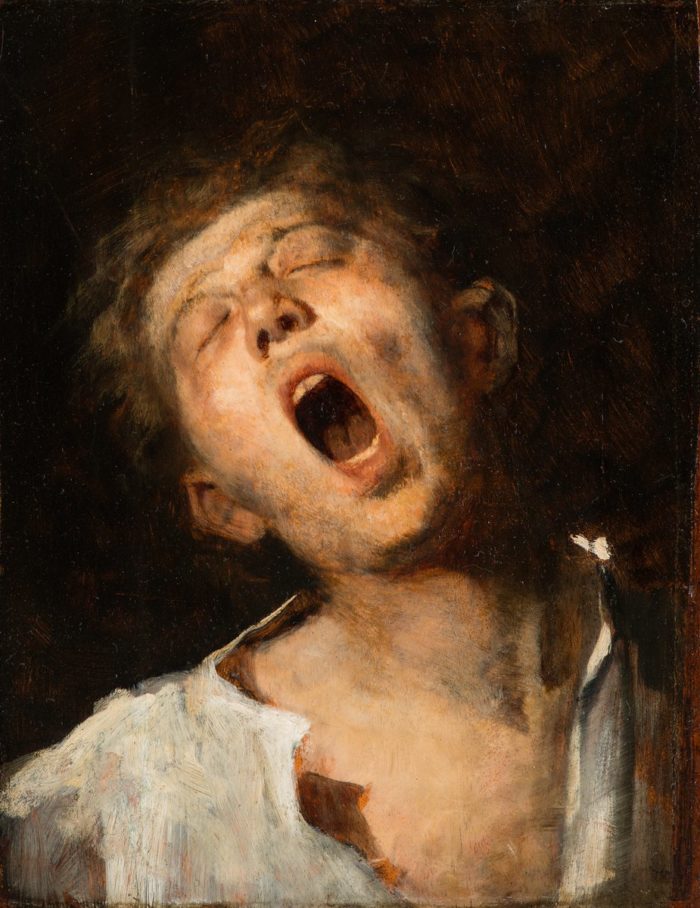
Mihály Munkácsy: Yawning butler
(1868-69; oil on wood, 31 x 24 cm; Hungarian National Gallery, Budapest)
His major early work, The House of Lamentations (1870), which achieved worldwide success, is an internationally significant product of critical realism with its dramatic contrasts of painting and its power of character portrayal.
Mihály Munkácsy: Mourning House
(1869-72; oil, wood, 87.5 x 115.7 cm; Hungarian National Gallery, Budapest)
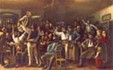
Mihály Munkácsy: Strike
(1895; oil on canvas, 159 x 251.5 cm; Hungarian National Gallery, Budapest)
This work was followed by several genre pictures, and his ability to depict characters and his strong, contrasting painting style raised the average of genre pictures (Night Tramps, 1873; Búcsúzkodás, 1873; Köpülő asszony, 1873, Hungarian National Gallery; Zálogpolitan, New York, 1874). His painting “Poros út” is a personal example of the plein air type of color perception in his oeuvre.
From the mid-70s, his art increasingly served the needs of the art trade, he was occupied with effective and attractive subjects, and he painted large-scale costume pictures. Some beautiful landscapes and richly picturesque interiors showed his talent, but his late works no longer reached the painterly value of his critical realist period. In this way, he had a great influence on his contemporaries László Paál, Géza Mészöly and later ones, in the 20th century. for lowland painters working at the beginning. The latter depicted the fate of the peasants, the struggle, the life of the people of the Great Plains in a conservative, reliable form of expression.
László Mednyánszky (1852-1919) was also among the internationally prestigious representatives of realism.
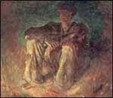
László Mednyánszky: Torn from a Branch (1900k)
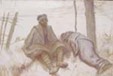
László Mednyánszky (1852-1919): In Serbia
(1914; oil on canvas, 67.6 x 100 cm)
His Pantheist-inspired landscapes were close to those of Barbizon, and his style was sometimes colored by impressionistic elements. In his main works, in his paintings of wandering heads, realism almost became a vision.
The artist colony in Szolnok, which was formally founded in 1901, has had naturalist still life and landscape painters working since the 1870s. Among them: Sándor Bihari (1855–1906; Before Bíró; 1885; Mrs. Varró; 1890); Andor Boruth (1873–1955); László Hegedűs (1870–1911); Nándor Katona (1864–1932); Károly Kernstok (1873–1940); László Mednyánszky (1852-1919); Dániel Mihalik (1869–1910); Károly Pongrácz (1872–1930); Lajos Szlányi (1869–1949); Vilmos Aba Novák (1894–1941); János Vaszary (1867–1839).
Along with those from Szolnok, one could list those from Hódmezővásárhely (János Tornyai, Béla Endre; Gyula Rudnay; János Pásztor), as well as Ferenc Medgyessy from Debrecen.
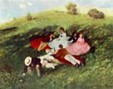
Pál Szinyei Merse: Majális
(1873; oil on canvas, 128 x 163.5 cm; Hungarian National Gallery, Budapest)
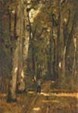
László Paál: Road in the Fontainebleau forest
(1876; oil on canvas, 91.5 x 63 cm; Hungarian National Gallery, Budapest)
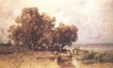
Géza Mészöly: Balaton fishing farm
(1877; oil on canvas, 140 x 226 cm; Hungarian National Gallery, Budapest)
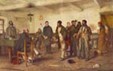
Sándor Bihari: Before the Judge
(1886; oil on canvas, 111.2 x 167 cm; Hungarian National Gallery, Budapest)
Mihály Munkácsy (born: Lieb Mihály, Munkács, February 20, 1844 – Endenich, Germany, May 1, 1900) Hungarian painter.
Munkácsy fought his way up from the depths, from a carpenter’s lad he became a famous painter who conquered the whole world with his enormous canvases. He was also the greatest “sociologist” of his time, an excellent connoisseur of the rural and urban communities of European and Hungarian society. He studied and painstakingly painted people caught up in their fate. He was a European, Christian and Hungarian citizen in one person and a brilliantly talented painter, but in order to create his huge oeuvre, great diligence, strained mental and physical work is necessary. He was a romantically realist painter who always created works full of invention. On his large canvases, he creates his compositions with rich types of people and toolkits, as if projecting the world of 20th-century character actors, numerous extras and lavish set materials, richly exhibited in colorful wide-screen films.
Géza Mészöly (Sárbogárd, May 18, 1844 – Jobbágyi, November 12, 1887) Hungarian painter.
Dezső Malonyai describes in detail the beginning of Géza Mészöly’s career in his article published in the Művészet magazine.[1] In 1867, Antal Ligeti, the keeper of the gallery, noticed a young boy who was copying the paintings of painters in the museum. Géza Mészöly was already studying law at that time. With Ligeti’s help, he got to Vienna, where he became a student at the Academy, finishing his studies in 1872. In 1873, he moved to Munich, where he had his own studio. He lived in Paris in 1882, and again in Budapest from 1885. Géza Mészöly was a landscape painter whose work is mainly associated with Lake Balaton. He liked to paint the landscape, the people living there, and fishing huts. He created his pictures with great care and meticulous elaboration. His art had a great influence on later landscape painters. From spring to autumn, he traveled the country, drawing excellent sketches, which he then developed in a naturalistic style in his workshop in the winter.
László Paál (Zám, July 30, 1846 – Charenton-le-Pont, France, March 3, 1879) was a Hungarian painter.
He is a close friend of Mihály Munkácsy, a distinctively Hungarian individual of the Barbizon school, plein air landscape painting, who inscribed his name in Hungarian art history with his oil paintings depicting forest details, painted with deep intuition and lyrical realism.
László Paál is still one of the most influential figures in Hungarian landscape painting, and his work played a major role in the subsequent popularization of the genre. His early works were characterized by dark colors and the play of light and shadow effects. Together with Munkácsy, they were great admirers of the art of the masters of the Golden Age of the 17th century, including Frans Hals and Rembrandt. During his trip to London in 1871, Paál studied the landscape paintings of John Constable more closely, after that his colors became lighter, and he also produced some water paintings under the influence of the English watercolor painters. His second trip to the Netherlands in 1872 had a completely liberating effect on his colorist tendencies, he painted more brightly and colorfully, and began to see nature in large, uniform patches of color.
His joining the Barbizon school was not without precedent: as early as 1869, he was introduced to the works of Gustave Courbet and other Barbizonians at the introductory exhibition of French painters in Munich. His tragically short life was completed after 1875, when he painted his main works. In his plein air paintings, following the principles of the Barbizonians, he primarily depicted nature, especially intimate parts of the forest, with great love. His strength was the depiction of the play of lights and shadows observed outdoors, which made his landscape paintings rich in deep brown and green tones suitable for expressing deep emotions.
Although his paintings have been exhibited at the Paris Salon since 1876, and he even received a bronze medal at the 1878 Paris World’s Fair for his painting Road in the Forest of Fontainebleau, Paál’s name and art only became known to the Hungarian public with the 1902 exhibition of his life at the National Salon. before. After that, he gained more and more popularity, and his works were presented at numerous exhibitions: in 1910, a memorial exhibition of his works was organized in the Könyves Kálmán Szalon, in 1925 in the Ernst Museum, and in 1954 in the Új Magyar Képtár. Paál left about seventy pictures, one year after his death, on April 20, 1880, sixty-five of his pictures were auctioned for 25 thousand francs. A significant part of his paintings is owned by the Hungarian National Gallery.
In his honor, the László Paál Society was founded in 1923, whose members mainly painted landscapes. The president of the artists’ association was Manó Vestztróczy for many years.
Paál’s art gained more and more popularity in the second half of the 20th century, tkp. In 1984, some high-quality copies were made of Path in the Fontainebleau Forest. of his image in Budapest at the Kossuth Printing House, and this also meant the interest of foreigners, because in this period the Kossuth Printing House mainly produced for export. There can be no doubt that landscape painting in the 20-21st century. Paál’s painting still plays a big role in his popularity in Hungary in the 19th century.